
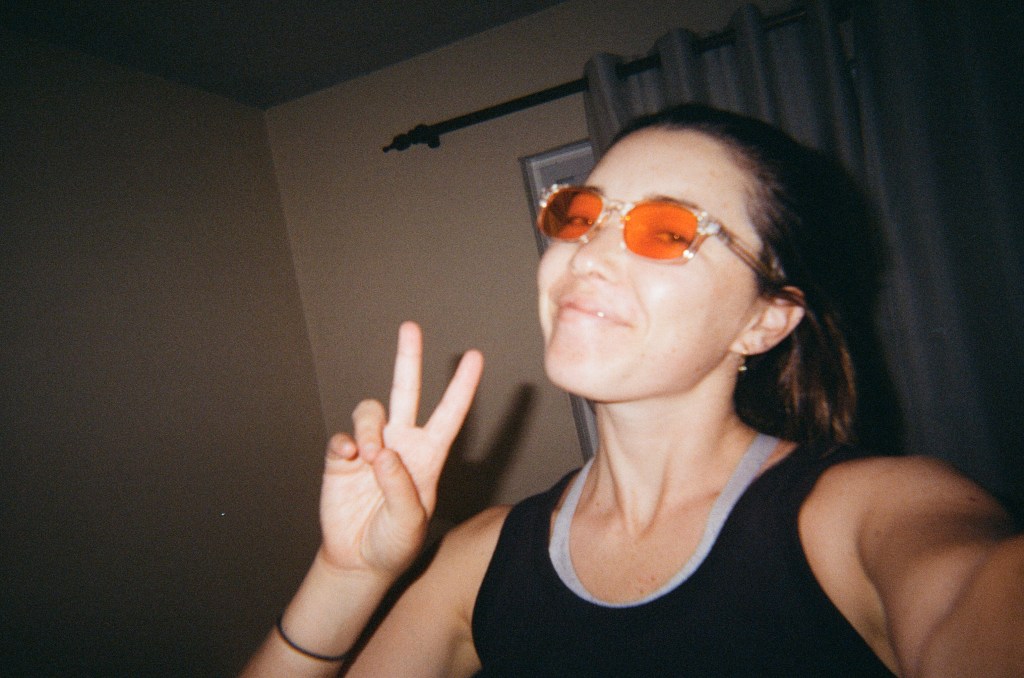
When people ask me how I’m recovering from years of severe Chronic Fatigue, I always have to read the room a little before answering. Do I give them the demure version? Or do I jump right in and tell them that I don’t drink coffee, but I will take it in an enema? Should I tell them about the mind-body work I’m doing or will they think it’s too left field? Lately, I’ve been learning to move past the shame around the alternative treatments that I do, embracing them and sharing them with an open spirit. After all, I know they work. My incredible recovery is a testament to that.
When I first became unwell with Chronic Fatigue I was in my early 20’s, a high-achieving, go-getter on the brink of starting my life post-university when doctors told me there was nothing that could be done. That was the response from the kind doctors. Others told me my blood tests were totally fine and that it was all in my head. One even advised me that if I went out and found a boyfriend I’d feel better. They looked at me like I was a silly young girl taking up their time and didn’t listen to my pleas for help seriously. “My brain won’t work anymore, I can’t get out of bed most days,” I’d try to explain, nobody understanding the extent of my symptoms.
I went from doctor to doctor with no helpful advice. “Eat well and rest, but 80% of people never recover again,” said one prominent immunologist before telling me, “Come back and see me in a few months.” For what exactly? I wondered as I paid the bill and booked another appointment, because where else would I go? I went home, cried for hours, then forced myself to stop. Not because I felt better, but because I was too drained to keep going. At 22, could I be one of the 80%? Was my life over before it had even begun?
Another doctor insisted it was depression and sent me to a psychiatrist. I only went to the appointment to prove her wrong. As expected, the lovely psychiatrist said I didn’t have depression. He kindly validated how I was feeling, pronouncing that the real, physiological symptoms I had were coming from something else. He just didn’t know what. This would be a terrible appointment for most people, but my expectations had become so low that just having someone believe in me was comforting.
Then, the psychiatrist suggested hypnosis. He told me our thoughts are powerful and showed me images of water molecules being changed by thoughts. He took me into a little room with no windows behind his office and I sat in a big armchair as he chanted mantras about how I would heal. I sat there trying not to laugh. He recorded it on a tape for me to listen to at home. We had to dig through the garage to find an old tape player. I still remember one of the lines that he chanted in an enthusiastic sing-song voice. “When you wake up, it’ll be the best day of the REST of your life, your life will get better and better.” I half-heartedly tried it. After all, he was the first doctor to actually suggest a possible solution. I laughed through his tapes. I was unable to see it at the time, but the joke wasn’t on this kind-hearted psychiatrist. It was on me. I was stuck, desperate and getting sicker and sicker.
My symptoms progressed and without anybody to help me, I started to wonder if the doctors were right and perhaps it was all in my head. I recall forcing myself to swim in our backyard pool, thinking I could push through and the symptoms would disappear. Getting to the pool completely depleted me. I had to lie sprawled across the pavement beside the pool recovering before I had the energy to get myself back inside. It was as though all the energy in my body had been squeezed out of me, like a brittle, useless dried-up sponge. At this period of my illness, when I overdid movement, I’d end up in bed for hours or even days after, in intense pain from the exhaustion.
When conventional medicine fails you and you find yourself in pain, of course you are going to turn to alternative methods. I remind myself of this when people scoff at my treatments or dismiss them as unproven. As a wise friend once pointed out, “If people are making fun of you, that’s a good thing. They don’t understand your desperation to escape pain and they haven’t had to suffer like you.” The ultimate in taking the high road. I certainly wasn’t going to fall into the 80% category without putting up a desperate fight.
First came the realisation that my diet could make a difference. One day it clicked in my mind that food was my fuel, and did I want good fuel or bad fuel? First I finished eating the pecan pie in the fridge, and then I started researching optimal diets. In hindsight, I did take it too far and got a bit obsessive over it. The low salicylate diet where I could only eat cauliflower and steak was a real low point. Eventually, I found a happy medium with a diet that works for me. No processed foods, gluten-free, dairy-free, sugar-free, low carb, with lots of healthy fats and grass-fed meats. I discovered food can be medicine. It’s just a subtler medicine than pharmaceuticals.
I found integrative medicine and some incredible doctors and naturopaths. Finally doctors who believed in my symptoms and understood me. One such practitioner, a kinesiologist, used a diagnostic tool called an Asyra, which led to my Lyme Disease diagnosis. I held onto two metal rods connected to a laptop, while low-voltage currents were transmitted through my body, measuring my response to these subtle electrical signals. The results from the Asyra testing were later confirmed by blood tests, which piqued my interest. Are we energetic beings? At the time, however, I wasn’t ready to go within and think about this any further.
When you have a complex chronic illness, you become an investigator. I became Sherlock Holmes, determined to solve the mystery of my own body. I’m not sure if Sherlock Holmes ever felt the need to take photos of a toilet bowl before flushing, but that’s what I found myself doing. The Hidden album on most people’s iPhones is usually reserved for something a little sexier than mine was at that time. I felt better about it once I read Yolanda Hadid’s account of her healing journey, and she unashamedly included some similar pictures in her book.
My desperation to feel better eventually took me overseas, where I did some experimental treatment for Lyme Disease. I was sedated and put into a heat chamber and my body temperature was raised to almost 42 degrees to kill off the Lyme Disease-causing bacteria, which is heat sensitive. I underwent this treatment four times. Twice in Malaysia, twice in Germany. Should I tell you about the time I woke up from sedation in a nappy, ripped it off in defiance, fell back asleep, and promptly shit myself? Or the time in Germany when apparently, as the sedation wore off, I was naked and started trying to punch the nurse who was trying to help me. She told me they were forced to sedate me again, and showed me where I’d punched a hole in the plastic equipment. Perhaps that should have been a sign of some pent-up anger and subconscious emotions I needed to express, but again, I wasn’t ready for it at the time. It did provide some laughs though, which had become quite rare at this point in my journey.
As time wore on, I made some improvements, but I wanted more. Gut health is a key area I had to work on, with colonics and coffee enemas becoming a regular part of my routine. The lowlight of my colonic experiences was probably in Germany when instead of a woman like I usually work with, a man in his 50s came to administer one. In his defence, he was a complete professional and extremely kind, but having an older German man tell you in a heavy accent to breathe and “It’s going in now, just gently, breathe” as he pushed a tube up my bum, was one of those moments where I thought, what has my life come to?
Coffee enemas were a revelation for me. I used to pay over $100 for glutathione IVs, which is one of the master antioxidants in the body essential for detox. This was before I learned that coffee has palmitic acid in it and when taken rectally can increase glutathione by up to 700 percent. I did them almost daily for a year at one point. They boosted my brain clarity and energy at a time when I was desperate to feel well. When people talk about cutting back on their coffee addiction, I’m tempted to shout how much I relate, just in reverse. “Bottoms up!” I’d announce as I’d head off to the bathroom each morning. Despite this laughter, I’d always ensure the enema kit was hidden when we had visitors. The chronic illness shame spiral ran deep after all.
In time, my patience waned and I wanted more healing than my super-regimented, supplement-heavy, physically focused treatment was giving me. It had been 8 years at this point and I was still mostly housebound, so honestly fair enough on the impatience. People kept mentioning the nervous system and this thing called brain retraining. “My son watched these videos and changed his thoughts and now he is almost healed,” I was told. This triggered me immensely. “I have REAL, PHYSICAL symptoms, I can’t just think myself better,” I’d say. It reminded me of the doctors who dismissed me in the earlier days of my illness and had told me the illness was all in my head.
They say when it rains it pours and at this point, my life was a comedy of errors. I hit my head on a table at home one day and ended up with a pretty serious concussion. The strange thing was that a bunch of old symptoms reappeared overnight. How could these symptoms that I thought were from Lyme Disease reappear overnight after a head knock? Was this a sign of a dysregulated nervous system?
My acupuncturist told me a story that confirmed this theory (yes, I still laugh at myself when I start sentences with, “My acupuncturist says”). He had a patient who had a concussion from a car accident involving a red car. Whenever something red came into her peripheral vision on the same side as the car, her symptoms would flare. Her brain had made a connection and learnt to see red as a threat. What if the same was happening to me? Had my brain been cross-wired, and was it seeing movement as a threat? Was it overwhelmed and stuck in fight or flight mode, and is that why the head knock caused so many random symptoms to reappear?
After listening to an inspiring recovery story, I signed up to an online program called DNRS (the similarity of the acronym to Do Not Resuscitate some kind of weird irony?). I watched the videos as they taught me how to calm my limbic system, and move my brain out of fight or flight mode and into a parasympathetic healing state. The instructor had printed posters for her floor and danced around the room performing this frankly whacky routine, speaking to herself at each poster using actions to teach her brain a new way of thinking and being, and then moving through a visualisation technique. I listened as they taught how our thoughts can influence our brains and bodies. “You can’t say the word symptoms anymore, you should call them ITs to remove your association with illness,” they instructed. I watched it, wanting to believe in it, but was unable to hide my scepticism.
Thankfully, something changed in me and I decided to give it a go. Desperation? A slight aberration in my ego and forthright attitude due to the concussion? I do see the irony that I spent years vehemently annoyed at anybody who expressed criticism of my “left-field” holistic treatments, declaring from my knowing high-horse that they weren’t open-minded enough, whilst I too called brain retraining and the mind-body connection rubbish.
I’ve since noticed a sign of true growth in me is when I come to areas of life without judgement, a beginner’s mindset, an open heart and a knowing that I have no clue what’s going on. I’m just here happy to be living and learning.
I joined some laughter yoga classes that DNRS ran and realised it had been years since I’d really laughed. I sat on Zoom with 20 others and a laugh instructor as we went through a routine with zero jokes and just forced laughter. I loved it! I was smiling all day after my first class, both at the absurdity of it all, but also because I thought it might work. I also loved the camaraderie of the group, all choosing to embrace joy to heal their chronic illnesses rather than becoming victims of their suffering.
I recall when I was in Germany, a physical therapist walked in, came close to me, and gasped, “You are deeply broken and unhappy. I can feel it in your energy.” I immediately burst into tears because I knew it was true. Illness had chained me down, and every day, I carried the weight of the world on my shoulders as I struggled to escape it.
I remember another time bargaining with the universe, thinking about all the things I’d willingly give away to have my health back. “I’d go one million dollars into debt,” I’d whine. “Take everything I own, take it all,” I’d proclaim with desperation looking up dramatically at the sky. Then down at my beloved dog wondering if I’d include her in the bargaining. Funny how I was always looking outside of me, grasping for something else or someone else who could heal me.
I decided to fully commit to myself and go within, adopting a new routine with brain retraining, meditation and a focus on regulating my nervous system. As I was “sitting on a horse, firing arrows” in my new morning Qi Gong routine, I realised something. The only person I had been firing arrows at was myself. I had been fighting with my body, not working with it. This inner conflict was the reason I wasn’t healing. I was regimented with my diet, supplements, routine and lifestyle, and had worked my nervous system to the brink. Trapped in overdrive, my nervous system was viewing the world through a lens of fear. I felt so much shame and guilt around being unwell and carried that around with me everywhere. I’d done all the work externally but had never looked truly within at my spirit and soul. I had lost the ability to love myself and had lost the carefree, fun version of myself.
Fully committing to brain retraining and healing, I finally began to open up again. I began to feel joy and hope and felt physical changes in my body. I pulled back on being so regimented and focused on the basics. Good food, sunlight, grounding, getting out into nature, swimming in the ocean, appreciating the flowers and the feeling of sun on my skin. I learnt how to wear my groovy blue blocker glasses without shame (at least around my housemate). I learnt how to let things go and surrender (a work in progress). I learnt about breathwork and immersed myself in books that taught me about psychoneuroimmunology, neuroplasticity and polyvagal theory. I learnt about how powerful our thoughts are and finally started a regular meditation practice. I listened to affirmations as I slept, infusing them into my subconscious. I contemplated reaching out to that psychiatrist, knowing we would have a lot to discuss these days. Honestly, I also wanted to see if he still used tapes. I rewired my brain’s negativity bias and started a group chat with my family where we sent pictures of any love hearts we spotted out in the world. A metaphor for how I was learning to see love, joy and peace in the world again.
I made a friend around this time who didn’t know my health history, and when I listed some of the things I never do like drinking or partying, he asked me, “When did you stop having fun?” While I know I don’t need to drink or party to have fun, it’s a question I ask myself now and it guides me. Healing for me has been about learning to have fun again. I dance around my apartment, teaching my body how to feel joy again as it had forgotten how. And I did that wacky little talk-to-my-brain-as-I-move-around-the-room visualisation technique routine that DNRS taught me for an hour almost every day for 18 months, and it worked! My symptoms started easing, and more importantly, I started to find myself again.
Over time, I realised that the answer I had been searching for was within me. The power to heal came when I committed fully to myself and chose to show myself love and grace. I learned to surrender with grace, and then surrender even more. Alongside this, I sprinkled in some science-backed neuroplasticity and targeted nervous system regulation exercises.
My experience of illness brought me to the edge. It was a true dark night of the soul. I’m a different person because of it, and I’m forever grateful for the lessons I’ve learnt and continue to learn. I’ve started on a personal growth journey that I know I’ll be on for the rest of my life. It’s brought me closer to my true and most authentic self. I’m still learning to embrace vulnerability, and sharing this story openly is part of that process. At the same time, I want to shout from the rooftops about the journey I’ve been on, in the hope that others stuck in that dark, desperate place, not knowing where to turn, might hear my call and learn that they too can heal themselves.
This post originally appeared on my substack that you can view here.
Note: My blog may contain some affiliate links. I will be paid a commission if you use this link to make a purchase at no extra cost to you. I only link to products or programs I have personally used


 ALEX MEEKA WELLNESS
Leave a reply to Lil Cancel reply